





Remarks by Deputy President Paul Mashatile during the Presidential Title Deed Handover to the Mtshoeni/Mtsweni family (Schulk Marhiqa CPA), Grootvlei Farm, Secunda, Mpumalanga
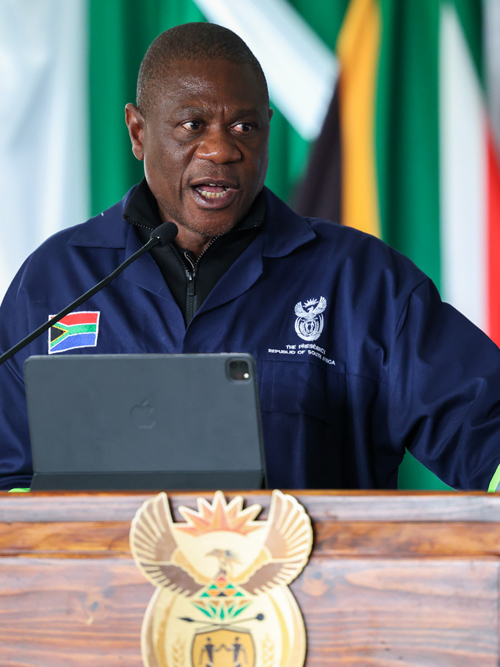
Programme Director; please allow me to start by acknowledging our hosts;
MEC of Human Settlements and COGTA, Mr Speedy Mashilo, who is also representing Premier Mandla Ndlovu;
MEC Khetiwe Moeketsi for Agriculture, Rural Development, Land and Environmental Affairs;
Executive Mayor of Govan Mbeki Local Municipality, Cllr Nhlakanipho Zuma;
Executive Mayor of Gert Sibande District, Cllr Walter Mngomezulu;
Minister of Land Reform and Rural Development, Honourable Mzwanele Nyhontso;
Deputy Minister of Land Reform and Rural Development, Honourable Stanley Mathabatha;
Chief Land Claims Commissioner, Ms Nomfundo Ntloko;
Chairperson of Schulk Marhiqa Communal Property Association, Mr Madlozi Mtshoeni;
Our esteemed Traditional Leaders present,
Most importantly, the distinguished Beneficiaries of the Schulk Marhiqa Communal Property Association, Osingabo;
Ngiyanibingelela nonke ngalolu suku olubalulekile kangaka!
I stand before you today with a heart filled with excitement as we celebrate a critical milestone in our path towards advancement, development, and restorative justice.
Today, we do more than hand over paper, we hand back dignity. The achievements of the Schulk Marhiqa Communal Property Association mark true progress in the restitution of land. This progress restores dignity, uplifts communities, and secures lasting opportunities for citizens. Your journey reflects a national story of unity, resilience, and the enduring promise of restoration.
When we talk about restoration, we are talking about a journey that Sol Plaatje so eloquently characterised in 1916 when he wrote of waking up one day as "a pariah in the land of his birth". This sentiment encompasses not only the loss of land but also a struggle for dignity and recognition for many communities.
This statement further highlights the cruel paradox faced by indigenous people, those who have ancestral ties to the land, who are marginalised and treated as outsiders, compelled to justify their rightful place in their ancestral territories.
This has been the story of many in South Africa including the Mtshoeni family. In the late 1700s, the family of Mtshoeni, settled in Grootvlei in this beautiful province of Mpumalanga.
The household of the family was led by Mr Schulk Ngazimbi Marhiqa Mtshoeni, who owned a large portion of land before it was appropriated under the Natives Land Act of 1913 and allocated to the Frans Herbs family.
Baba Marhiqa was recognised as one of the most successful farmers, cultivating maize, corn, and raising herds of cattle and sheep. Around 1934, the farm was taken from him, and the Herbs family entered into an agreement to cultivate maize and corn, with the profits shared equally.
The Native Land Act resulted in significant socio-economic consequences for his descendants, who were relegated to the status of farm workers, lost their livestock, and were deprived of their rightful inheritance, reflecting the broader impact of systemic land dispossession on indigenous populations.
We are pleased to note that your story as the Mtshoeni family does not conclude with the event of human rights abuse related to dispossession. Instead, your narrative aligns with the sentiments of many South Africans who assert that our collective story must evolve beyond a history of exclusion, especially now that there exists a democratic dispensation in which there is a mechanism for restoration through land restitution.
In this regard, in 1998, the family initiated a claim to restore their ancestral land, a process that entailed extensive years of investigation, negotiation, and even personal sacrifice. This claim has since been validated, culminating in the return of more than 627 hectares of land, specifically Portions 24 and 26 of Grootvlei Farm, to its rightful custodians.
The return of this land therefore embodies the restoration of identity, a sense of belonging, and opportunities for the family that were dispossessed.
What makes this title deed handover special for us is that it takes place during Human Rights month, transforming a routine administrative task into a powerful act of restoring human dignity and reversing historical injustices.
Each hectare restored is not only a stride toward healing, but a living testament to justice fulfilled.
Each title deed handed over is a promise kept by our democratic Government, a covenant between the democratic state and its people.
These title deeds are the direct consequence of honouring land restitution rights. For thirty years, the Commission on Restitution of Land Rights has stood as a pillar of transformation, steadfast in its mission to heal the wounds of our past.
Today’s celebration is living proof that restitution is practical, that it is empowering, and it is nation‑building.
Receiving land is not the end of the journey. It is the beginning of responsibility. Now a new chapter opens, one that demands stewardship, productivity, and vision. If the land remains fallow, the promise of restitution is left unfulfilled. It is therefore important that we dedicate ourselves to cultivating the land whether through farming, sustainable development, or community projects. By doing so, we transform restitution into restoration.
I can never over emphasise this, ladies and gentlemen, that we must never neglect the land. For it is the soil beneath our feet that carries the memory of our ancestors and the promise of our children. To neglect it would be betrayal to the very struggle that defined our liberation.
We must prove through action that our fight for the land was worth it and that it was not in vain. We must not allow any action that will make our policies appear detached from the daily lives of our people. Rather, they must be living instruments of justice, ensuring that the farmer tills with hope and the nation prospers with unity.
I commend the Schulk Marhiqa CPA which I am told is already farming 100 hectares of maize and 30 hectares of soybeans, alongside livestock. We all know that Mpumalanga is one of South Africa’s breadbaskets, producing millions of tons of maize and soybeans annually.
With the support of the Department of Land Reform and Rural Development and partners such as SAGRA, this community is positioned to thrive and prosper.
Government is pleased that post-settlement support has provided tractors, planters, trailers and livestock. More importantly, it has created jobs, built skills, and opened pathways for youth and women to participate in agriculture. This is economic empowerment in action.
On a broader scale, Government is facilitating community land management through Communal Property Associations (CPAs). On October 9, 2024, President Cyril Ramaphosa signed the Communal Property Associations Amendment Bill, which modifies the 1996 Communal Property Associations Act.
These amendments aim to enhance the rights of community members involved in CPAs and clarify their objectives, establishing that land ownership lies with the residents who are part of these associations, as opposed to the associations themselves.
Government is leveraging land redistribution to rectify historical injustices while concurrently promoting agricultural production, stimulating rural economies, and generating employment opportunities. By employing rights-based interventions and addressing disparities in ownership and wealth distribution, the Comprehensive Rural Development Programme is striving to improve living conditions and welfare, effectively rectifying past injustices.
Today, as we hand over these title deeds, we affirm that South Africa belongs to all who live in it. We affirm that dignity denied can be dignity restored. And we affirm that the promise of our Constitution, to heal the divisions of the past and build a united prosperous future, is alive here in Grootvlei and it will continue to spread across all corners of South Africa.
Let us leave here with renewed commitment to protect this land, to cultivate it, and to ensure that justice is lived in the daily lives of our people.
Let Grootvlei be a beacon that justice delayed can be justice delivered, and that restoration here is restoration everywhere.
Once more, congratulations to the Schulk Marhiqa CPA.
Siyabonga kakhulu, Thank you!
.png)

.png)

